

Author Marlowe Granados on the Legacy of Gentlemen Prefer Blondes
In celebration of the classic's 100th Anniversary


If everyone underestimates you, you're bound to surprise someone.
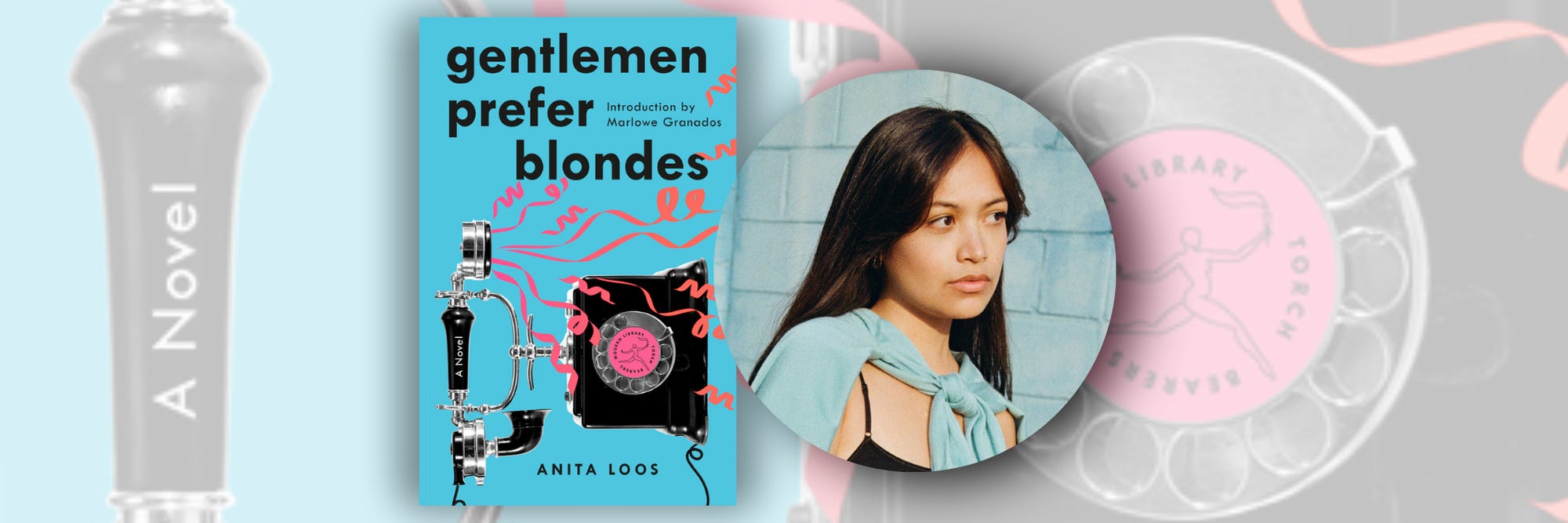
This year marks the 100th anniversary of Anita Loos's iconic novel Gentlemen Prefer Blondes, and Penguin Random House's Modern Library has just released a new edition of the book that Edith Wharton famously called "the Great American Novel." The new release features an introduction by author Marlowe Granados, whose own novel Happy Hour drew inspiration from Loos's satirical masterpiece.
I spoke with Granados about the enduring legacy of Gentlemen Prefer Blondes, the inspiration she drew from Lorelei Lee's adventures, and what we've learned—or perhaps haven't learned—about women, money, and society in the century since its publication.
Have you read Gentlemen Prefer Blondes? (Or seen the movie?) Any 100-year-old Classics you love?
What was your first encounter with Gentlemen Prefer Blondes, and what about it stuck with you?
I came to the Howard Hawks film starring Marilyn Monroe and Jane Russell first. When I was about twenty I read the novel by Anita Loos. From a very young age I've loved stories about women on an adventure. Gentlemen Prefer Blondes has a pair of beautiful women on a very feminine kind of adventure full of mischief and very little consequence. You know that they're going to be absolutely fine. In the Hawks film there's a line where a bunch of men see Jane Russell and Marilyn Monroe board the ship to France and one of them says, "Those girls couldn't drown." Similarly to the novel, you just know these young women are unsinkable. That's something I really love, and from a very young age have aspired to.
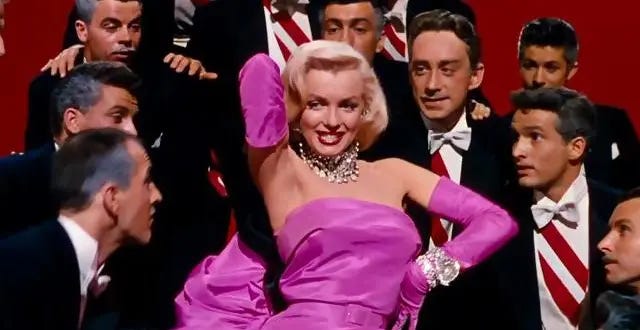
In what ways do you see Gentlemen Prefer Blondes as a feminist—or at least proto-feminist—text? Do you think it still holds that power today?
Unfortunately, I think it does hold up. An easy kind of misogyny is thinking a woman who cares about how she presents herself is vapid or unintelligent. There are so many layers of survival that these young flappers are up against, but they're going above and beyond just surviving. They want to luxuriate in whatever way they can get a hold of. They're wily without men having a sniff of suspicion about their intentions. They want to conquer! Whether that's London, New York, or Paris. What a fun world to live in, even if it's still a slight fantasy.
What about Anita Loos' voice or style do you think remains radical or refreshing 100 years later?
That it has such a developed style and wit which feels so spare in our current era. It trusts its readers to be in on the joke, and I think we've lost a lot of that play in fiction. Humour and fun can still be a part of serious literature, it's frankly underserved.
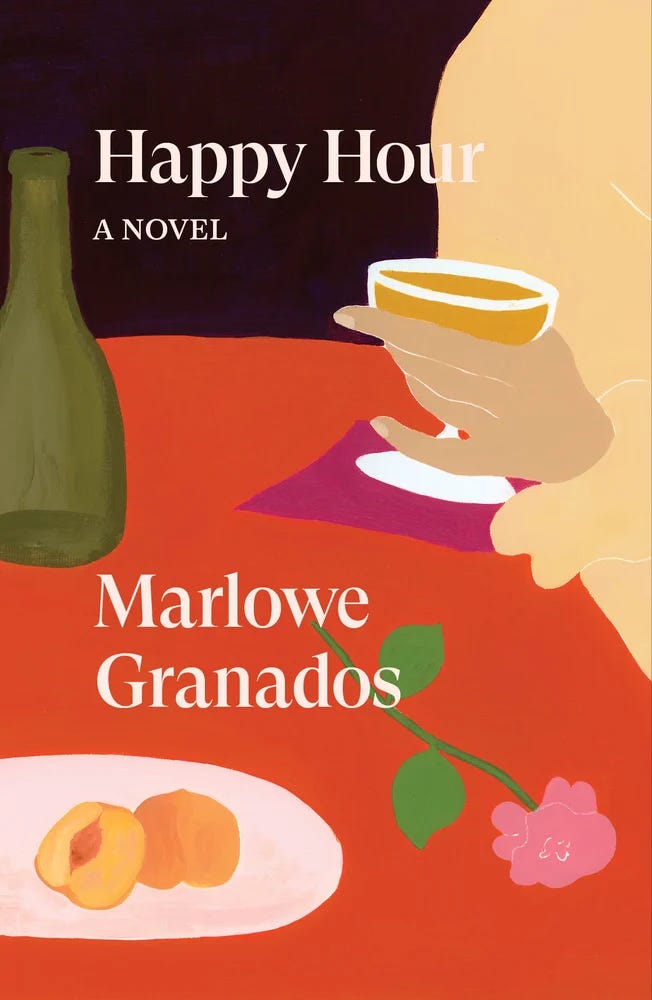
What inspired you—stylistically or thematically—from Gentlemen Prefer Blondes when writing Happy Hour?
I make sly references to Gentlemen Prefer Blondes throughout Happy Hour. I always think of the Loos novel as being an ancestor of Happy Hour. I wanted to take the lifestyle of a flapper and transpose it onto contemporary life and see what still works. It's funny that in Loos's novel they're getting diamonds and coats, whereas in Happy Hour, the girls are over the moon when dinner is paid for. Of course, making Happy Hour a diary was completely inspired by Gentlemen Prefer Blondes. I was fascinated in the telling and re-telling of something, of a performance in a diary, and the performance of a personality in a physical document that is then the only proof one has when you're gone. There's no one to dispute the diary if you're the only one with the sense of keeping a "record" of your point of view. I like the idea of women having the last word.
Both novels center on clever women who play a little dumb to survive. What is it about that persona that fascinates/interests/intrigues you as a writer?
If everyone underestimates you, you're bound to surprise someone. I think that is a fun thing to play with. Even though this subject is my bread and butter as a writer, people still underestimate me being in on the joke. Again, I love a feminine lineage. The idea that women have had to be charming in order to get into rooms that weren't open to them, or to live the life they want, that's nothing new. There's so much meat to it. At the time of writing Happy Hour, that was the world I lived in. There were so few stories I could look to where women didn't suffer for all the mischief they did. It feels very moralistic, and a clever woman who plays a little dumb and gets what she wants and laughs about it is just... perfect!
How do you think the meaning or reception of the “blonde” archetype has shifted in the century since the book came out—and what space does that leave for modern explorations?
I think "blonde" has more to do with femininity than with a hair colour. Since most blondes take great lengths to keep blonde, I think it's attention to the upkeep that has always made people associate that with "dumb". The lengths one takes to upkeep femininity, which is something people mistake as froth or frivolity. There are still so many modern explorations possible. People react so insanely to Sabrina Carpenter's practically vaudeville performance of being a "blonde", that it's unfortunate people still don't get it. I don't know why it's so hard for people to hold two truths at once.
Anything else you’d like to add?
Bring on the Loos Renaissance!
Marlowe Granados is a writer and filmmaker. After spending time in London and New York, she now resides in Toronto.
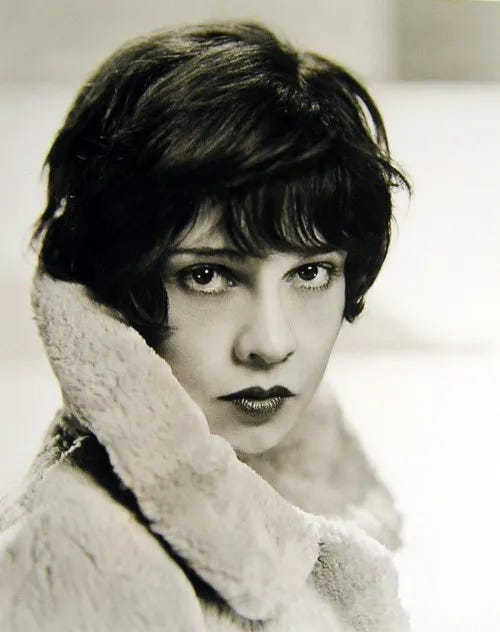
Anita Loos was born in California in 1888. She began writing movie scripts and supplied film scenarios for D.W. Griffith and Douglas Fairbanks. First published in 1925, Gentlemen Prefer Blondes was a best-seller in thirteen languages and was followed by its sequel, But Gentlemen Marry Brunettes. Anita Loos was the author of the novels A Mouse is Born and No Mother to Guide Her and two volumes of autobiography, A Girl Like I and Kiss Hollywood Good-by. She died in 1981.
 | A guest post by
|