


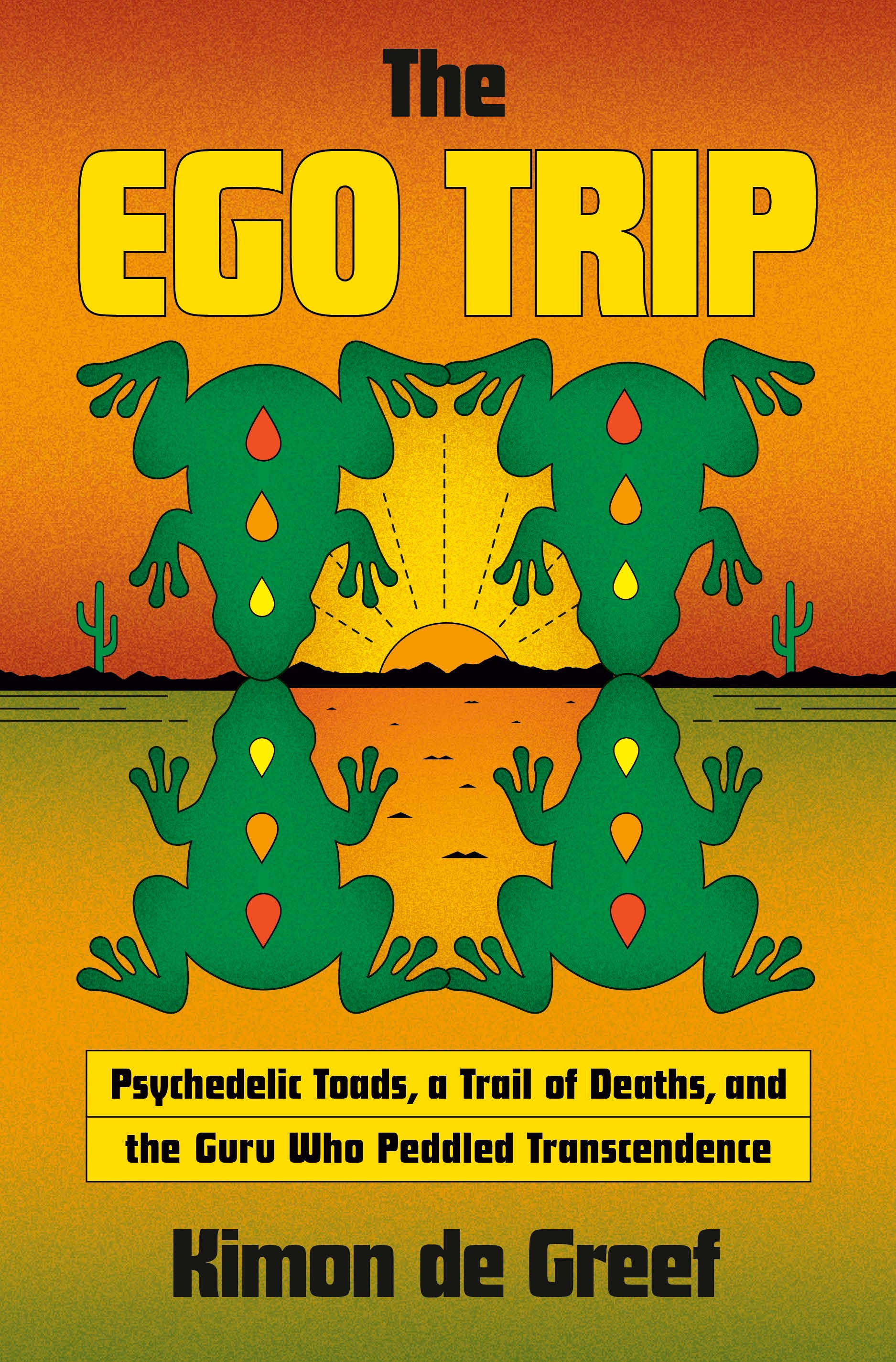
I’ve (generally speaking—hi, mom!) always been a rule follower and ever since receiving my D.A.R.E. certificate in elementary school was meticulous about just saying “no.” Didn’t smoke pot for the first time until well after college and the idea of any other drugs seemed far too risque and rule-breaky. But the older I’ve gotten and the more life I’ve experienced I’ve been fascinated by psychedelics and the way they’ve been known to interact with our brains and the way we see the world. So when I was approached about Kimon de Greef’s The Ego Trip, I wanted to feature it in some way, because we should all be talking about this! And it’s Patrick Radden Keefe-esque in its reporting and storytelling. (PRK himself says the book is “Entirely mesmerizing. . . . Richly reported and written with humor and flair”)
Thrilled to share this, what I’m calling, Narrative Playlist from Kimon—he gives us a taste of the book through sharing why he picked each song for the playlist.
Check it out below and get your copy of the book today!
Part true crime, part cult story, part cultural history, The Ego Trip is a chronicle of the rise and fall of a messianic figure and an investigation into larger truths about our age of spiritual desolation.
I never imagined I’d spend the better part of five years writing about one of the most powerful psychedelics in the world, but that’s something I love about journalism: following the breadcrumbs of a story without knowing where they might lead. In creating this playlist, I’ve chosen songs that brought to mind some of my experiences while working on The Ego Trip. You needn’t be in an altered state to enjoy them.
I fell into this story in 2020, when I heard about the phenomenon of psychedelic toad poaching in the Sonoran Desert — the most dissonant supply chain imaginable, where people seeking transcendent spiritual experiences were fueling a harmful economy for the animals. (For a less ethically fraught trip, one can consume the drug in synthetic form.) The first person I spoke to was Robert Villa, a conservationist in Arizona who also happens to be a virtuoso violinist. This piece he shared makes me think of the desert coming alive after the summer rains, when the toads emerge from their hiding places underground.
Sonoran Desert toads are strange and wonderful. I fell in love with them while doing this book. They are amphibians (highly dependent on water) that have evolved to survive in the desert, and they are the only animal in the world that produces the psychoactive compound 5-MeO-DMT. They are huge, brawny, opportunistic creatures that mate and feed riotously during the brief spell when they come to the surface. I am reminded of their energy by this Talking Heads song.
5-MeO-DMT is unlike any other drug in its effects, which unfold extremely quickly and often include sensations of ego death. “It’s like dying and being reborn,” Mike Tyson, an adherent of toad smoking, has said. The experience can be blissful and induce feelings of cosmic oneness, but it can also be profoundly terrifying. This track — a great reggae cover of the original — captures the tension in a simple lyric: “Want to see heaven, but I don’t want to die.”
The practice of toad smoking was popularized by a charismatic doctor from Mexico, Octavio Rettig, who used the substance to heal himself from a crack cocaine addiction. He brought relief to thousands of people around the world, but he also caused a great deal of harm, including several deaths. His story made me think about the risks of spiritual bypassing, a term for when people identify with their higher selves while losing sight of their flaws and wounds. This Massive Attack song with Mos Def seemed like it fit.
Octavio’s boldest claim (and the most tenuous) was that he had resurrected a lost tradition of toad smoking among the Seri, an impoverished tribe in Northern Mexico. The Seri had almost been killed off in a series of brutal wars with Spanish and later Mexican forces — by the early 20th century there were fewer than 200 survivors. These haunting recordings are of an elder named Miguel Barnett, a keeper of traditional songs whose grandsons later became addicted to crystal meth and became Octavio’s doorway into the community. (Octavio repurposed many of these songs to perform during his psychedelic ceremonies.)
One of the wildest scenes I witnessed with Octavio was during a psychedelic retreat he was running in Sonora. He had been admonishing one of his followers for some infraction and then stormed off to smoke a joint in his truck while others in his entourage scrambled to change a flat tire. He was blasting this psychedelic trance track at top volume. Then he called for an impromptu photo shoot and, while posing, ran toward the man he’d been angry with and knocked him over with a flying kick. The next day, the man showed me a tattoo of Octavio on his shoulder and whispered, “Whoever gives you the milk, the mother becomes.”
Another storyline I followed in this book is the quest to turn 5-MeO-DMT into a prescription drug for psychiatric disorders. Two companies are currently in a furious race to win regulatory approval, and at some level the whole thing has the feel of an espionage thriller, which is why I chose this suspenseful trip-hop song by Funki Porcini.
I won’t give too much away, but near the end of my reporting I had an inadvertent psychedelic experience at the hands of Octavio. During the trip, my driver (the brilliant Mexican artist Miguel Fernandez de Castro) played this song by The Alan Parsons Project. It felt spookily omniscient and quite funny at the same time.
More related to process than content: I enjoy dub music a lot and often played this track (and others like it) while writing.
Writing this book sometimes left me with a sense of wearying cynicism, but I was also reminded how beautiful and fascinating the world is, and how extraordinary our own existence can seem if you stop and think about it for a moment. So to end off, here’s a song about finding your light and letting it shine.

KIMON DE GREEF is a freelance journalist and researcher from South Africa. His work has appeared in The New Yorker, The New York Times, The Guardian, Guernica, National Geographic, and other publications. He is the coauthor of Poacher: Confessions from the Abalone Underworld and has written widely on illicit trades. He has a master's degree in conservation biology from the University of Cape Town and a master's in journalism from New York University. He lives in Cape Town, South Africa.

I was a child of the Just Say Yes 70s, did my share of acid in high school and college including a memorable Pink Floyd concert. "Wow, man, the colors! Um we're home, this is your house. Oh." I remember the legendary toad thing. Went to Mexico on spring break my freshman year at college but even as an idiot 18 year old I drew the line at smoking toad! Impressed with your courage.